What Do an Orange, a Robot and a Cup of Coffee Have in Common?
13th July 2026
The remarkable journey of everyday words across the world.
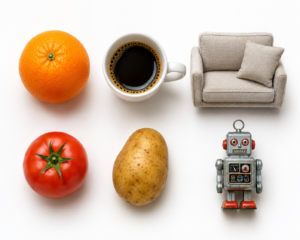
At first glance, there seems to be very little connecting an orange, a cup of coffee, a tomato, a sofa, a potato and a toy robot.
One is a fruit.
Another is a piece of furniture.
One is a vegetable.
Another belongs to science fiction.
Yet they all share one extraordinary characteristic.
None of their names began life in English.
Every one of these everyday words has travelled hundreds, sometimes thousands, of miles before arriving in our vocabulary. Their journeys reveal something remarkable about English itself.
Far from being a language that developed in isolation, English has spent centuries welcoming words from every corner of the globe.
Perhaps that is one of the reasons it has become one of the world’s richest and most expressive languages.
A language that loves to borrow
Unlike some languages, English has never been particularly protective of its vocabulary.
Instead, it has happily adopted useful words whenever it encountered new ideas, foods, inventions or cultures.
Every borrowed word carries a small piece of history.
Let us look at a few familiar examples.
Orange
The fruit travelled a long way before its name reached England.
Its linguistic journey began in Sanskrit before passing through Persian, Arabic, Spanish and French.
By the time English adopted the word, it had already crossed continents.
Interestingly, the colour itself was later named after the fruit. Before that, English speakers often described the colour as a shade of red or yellow.
Coffee
For millions of people, coffee is simply part of the morning routine.
Its name, however, tells the story of global trade.
The word travelled from Arabic through Turkish and Italian before entering English.
Every time we order a coffee, we are unknowingly using a word that has crossed cultures for centuries.
Sofa
Comfort has international origins too.
The word sofa derives from Arabic, where it referred to a raised platform covered with cushions.
As the concept spread westwards, so did the word.
Today, it is so familiar that few people realise it began life thousands of miles away.
Tomato and Potato
These two kitchen staples arrived in Europe from the Americas.
Their names originated in Indigenous languages before passing through Spanish into English.
They remind us that exploration did not simply move people and goods around the world.
It also moved language.
Robot
Unlike the other words in this article, robot is surprisingly young.
It first appeared in a Czech play in 1920.
Derived from a Czech word meaning forced labour or servitude, it quickly spread across the world as technology captured the public imagination.
Today, it has become one of the most internationally recognised words in existence.
Why does this matter?
It is easy to think of English as a single language with a single history.
The reality is far more fascinating.
English is a collection of journeys.
Every borrowed word tells a story of exploration, trade, migration, innovation or cultural exchange.
Language does not develop behind closed doors.
It evolves wherever people meet.
Every conversation, every voyage and every new idea leaves its mark.
The hidden work of translation
Borrowed words also remind us that communication has always depended upon understanding between cultures.
Long before the internet connected the world, merchants, explorers, diplomats and translators were helping ideas travel from one language into another.
Translation is not simply the exchange of words.
It is the exchange of knowledge.
Every borrowed word is evidence that cultures have been learning from one another for centuries.
A language built through curiosity
Perhaps that is why English continues to evolve today.
New technologies create new vocabulary.
Popular culture introduces expressions that spread around the world in weeks rather than generations.
Other languages continue to contribute fresh ideas, just as they always have.
English is not finished.
It is still collecting stories.
Final thought
Look again at the six objects.
An orange.
A coffee.
A sofa.
A tomato.
A potato.
A robot.
They seem ordinary.
Yet each carries the memory of another language, another culture and another chapter in humanity’s shared history.
Perhaps the most remarkable thing about English is not the words it invented.
It is the extraordinary number it welcomed.
Discussion
Which everyday English word surprised you most when you discovered it came from another language? Can you think of any others whose origins tell an equally fascinating story?
