The Reassurance That Is Not: Why Back-Translation Can Mislead
24th March 2026
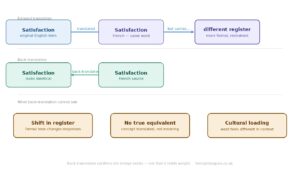
Back-translation has become something of a standard reassurance in international research. The process is straightforward: translate your survey into the target language, then have a separate translator render it back into English. If the two English versions match, the translation is deemed sound.
It is a logical step. It is also, on its own, an insufficient one.
What Back-Translation Actually Tests
Back-translation checks whether a translation is reversible. It asks: can a second translator reconstruct the original from the translated version?
That is a useful test of internal consistency. It is not, however, a test of whether the translated survey will be understood as intended by the people who actually complete it.
A question can survive back-translation perfectly – identical wording, intact structure, clean grammar – while still asking something subtly different in the target language. The meaning has bent. The back-translation simply cannot see it.
The Limits of a Two-Step Mirror
Consider what back-translation cannot detect:
A translated question may carry a different social register, more formal, more blunt, more deferential, than the original intended. Respondents pick up on this, and it shapes how they answer.
A concept embedded in the original may have no true equivalent in the target language. The translator has made a reasonable choice. The back-translator has faithfully reproduced it. Neither version flags that the underlying concept has shifted.
Idiomatic constructions, especially those common in research instruments, such as hypothetical scenarios or degree-of-agreement phrasings, may read naturally in English while translating into something stilted, ambiguous or culturally loaded elsewhere.
Back-translation confirms that a word-level bridge exists between the two versions. It does not confirm that the bridge holds weight.
What Rigorous Quality Assurance Looks Like
The gold standard in research translation goes further than back-translation alone. It typically includes:
Forward translation by a specialist who understands both the target language and research methodology. This is not a general linguist, but someone who knows how survey questions function and how respondents are likely to interpret them.
Independent review by a second specialist, examining the translated instrument not for literal accuracy but for cultural and contextual equivalence.
Reconciliation, where both translators and, where possible, a methodologist discuss and resolve discrepancies. The aim is not consensus for its own sake, but clarity of intent.
Cognitive testing where feasible, putting the translated instrument in front of a small group of target-language respondents and probing how they understood each question.
Back-translation may form part of this process. It is most valuable when used not as a final sign-off, but as one input among several.
The Quiet Risk
The danger with back-translation as a standalone check is not that it is wrong. It is that it looks right. It produces a document. It generates a comparison. It offers a moment of reassurance that can, in practice, close down further scrutiny.
In international research, false reassurance is more damaging than acknowledged uncertainty. At least uncertainty prompts questions.
The Standard Worth Holding
Translated research instruments deserve the same methodological rigour as the research design itself. Language is not a finishing step. It is a fundamental variable, one that shapes what respondents understand, how they feel about the question and ultimately what they say.
Back-translation is a starting point. For research that needs to travel, it should not be the last word.
Foreign Tongues works with market research agencies to provide specialist translation and quality assurance for international studies.
