What the Numbers Do Not Tell You
18th March 2026
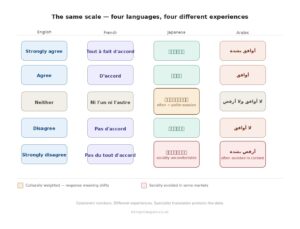
In quantitative research, the numbers are supposed to speak for themselves. Percentages are compared. Indices are built. Confidence intervals are calculated. The data is clean, the methodology is sound and the report is delivered.
But in international research, there is a question that often goes unasked:
Did all respondents understand the scale the same way?
Because frequently, they did not.
The scale is not neutral
A five-point agreement scale looks objective. It is the same in every market. It has been used across thousands of studies. Researchers trust it.
But the scale is a language too.
In some cultures, selecting the extreme end of a scale – strongly agree, strongly disagree – is socially uncomfortable. It signals aggression, or certainty, or a willingness to criticise that many respondents are conditioned to avoid.
In others, the middle point carries none of the ambivalence it implies in English. It is simply the polite option.
The result is data that is numerically comparable but culturally distorted.
When translation makes it worse
A poorly translated scale compounds the problem.
If “strongly agree” is rendered in a way that implies forcefulness rather than conviction, respondents in certain markets will actively avoid it, regardless of how they actually feel. If “neither agree nor disagree” sounds like a non-answer in the target language, respondents may avoid it too, clustering unnaturally in adjacent options.
The bias is invisible in the data. The distortion is real.
What specialised translation changes
When scales, instructions and response options are translated by linguists with market research experience, something different happens.
They do not simply render the words. They consider:
- how response options will feel to respondents in that language
- whether the implied social weight of each option is preserved
- whether the logic of the scale survives cultural translation
This is not editing. It is interpretive expertise applied at the point where data quality is determined.
The cost of getting it wrong
Misaligned scales produce findings that mislead with confidence. Differences between markets appear to reflect genuine opinion when they reflect translation friction. Similarities appear where real differences exist.
Decisions are made. Strategies are built. The data never raises a flag, because the numbers were always consistent.
Consistent, but not equivalent.
What rigorous research requires
The strongest international studies do not simply translate questions. They translate the entire research experience, including how it feels to a respondent to answer each option, in their language, within their cultural context.
That is the work that protects the integrity of global data.
And it does not happen automatically. It requires the right people.
Foreign Tongues specialises in translation and localisation for market research. If your next international study involves quantitative fieldwork across multiple markets, we will help.
