The Translation Brief That Arrives Too Late
11th August 2026
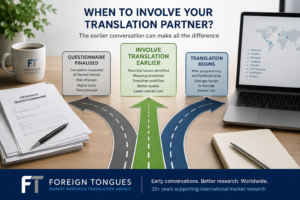
Why the best time to involve your translation partner is often before the questionnaire is finished.
There is a familiar moment in an international research project.
The questionnaire has been written.
The methodology has been agreed.
The sample is being organised.
Fieldwork is approaching.
And then someone says:
“We need this translated into eight languages.”
The translation request arrives.
The clock starts.
And suddenly translation becomes a race against the fieldwork deadline.
After more than 25 years working with market research agencies, I have seen this situation repeatedly.
And my advice is surprisingly simple:
Do not wait until the questionnaire is finished.
Translation is not simply the final production stage of an international research project.
It can influence the quality of the research itself.
Consider a questionnaire containing:
- rating scales;
- technical terminology;
- brand language;
- concepts that have no direct equivalent in another language;
- programming instructions;
- respondent-specific text;
- or questions whose meaning depends heavily on context.
A translator working from a Word document several days before launch may be able to produce an excellent linguistic translation.
But they may not have the opportunity to ask the question that matters most:
“What exactly does the researcher intend this question to mean?”
That conversation is much easier to have before the project reaches its final production stage.
The earlier conversation can prevent later problems
At Foreign Tongues, we encourage Clients to involve us as early as practical in a multilingual research project.
That does not mean the questionnaire has to be finished.
Quite the opposite.
Early visibility can allow our linguists and project managers to identify potential issues before they become expensive or time-consuming to correct.
For example, a seemingly straightforward English expression may require a different construction in another language.
A response scale may need careful consideration.
A programming instruction may need to remain untouched.
A question may require clarification because its intended meaning is not immediately apparent from the English source.
None of these necessarily represents a problem.
But discovering them after programming and fieldwork preparation can be.
Translation should be part of the workflow, not an emergency at the end of it.
This is particularly important when a study is being launched simultaneously across multiple markets.
The more languages involved, the greater the potential cost of discovering a linguistic or cultural issue at the last minute.
Good project management therefore is not simply:
English → Translation → Delivery
It is closer to:
Research design → linguistic review → translation → checking → programming → fieldwork
The precise workflow will vary from project to project.
But the principle remains.
The earlier we can understand what the research is trying to achieve, the better we can help protect that objective in every language.
A final thought from Foreign Tongues
The cheapest translation is not necessarily the one with the lowest quotation.
It may be the translation that does not have to be redone because an issue was identified before it reached programming or fieldwork.
That is why we do not regard ourselves simply as a supplier waiting for a questionnaire to arrive.
We regard ourselves as part of the international research process.
And sometimes the most useful thing we can do for a client is to ask a question before we translate a single word.
Planning an international study?
If you are preparing research for multiple markets, we would be very happy to discuss the project before the questionnaire reaches its final stage.
Foreign Tongues – The Market Research Translation Agency
25+ years supporting international market research.
