The Most Dangerous Word in International Research Is Not ‘Translation’
28th July 2026
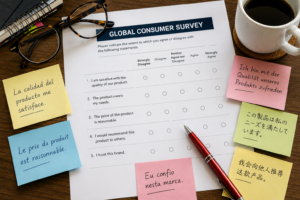
It is ‘Equivalent’.
During my years working with international market research agencies, I have learned that the biggest problems rarely begin with poor translation.
They begin much earlier.
They begin when everyone in the project assumes that a survey question means exactly the same thing in every country.
It almost never does.
And that is why one word has become, in my view, the most dangerous in international research.
Equivalent.
“Just make it equivalent.”
Clients say it all the time.
Researchers write questionnaires in English, then quite reasonably ask whether the translated versions are “equivalent.”
It sounds straightforward.
It is not.
Because equivalent does not simply mean using different words with the same dictionary definition.
It means producing the same understanding, the same emotional response and the same intent in entirely different cultural contexts.
Those are very different challenges.
A simple example
Imagine a survey asking:
“I feel comfortable challenging my manager.”
A literal translation is rarely the problem.
The challenge is cultural.
In some countries, openly disagreeing with a manager is viewed positively and may even be encouraged.
Elsewhere, it could be considered disrespectful.
Respondents are not answering the same question.
They are answering different cultural interpretations of it.
That distinction can materially affect the findings.
Translation does not create research quality.
Research design does.
Translation supports it.
Professional translators can produce excellent linguistic work.
But if the underlying concept does not travel across cultures, the research team needs to recognise that before fieldwork begins.
Sometimes the best translation decision is to ask:
“Is this really the question we want respondents in this country to answer?”
That is a research discussion, not simply a linguistic one.
What experienced researchers do differently
The strongest international studies do not treat translation as the final production step.
They involve language specialists early.
Not because they expect problems.
Because they want confidence that every respondent is answering the same underlying question.
That is where translation becomes a contributor to research quality rather than an administrative task.
Final Thoughts
At Foreign Tongues, we have learned that successful multilingual research is not built on word-for-word accuracy alone.
It is built on conceptual equivalence.
When respondents in twelve countries understand the same idea, even if the wording differs, that is when international research begins to produce genuinely comparable insight.
Translation matters.
But understanding matters even more.
Discussion
Have you ever encountered a survey question that worked perfectly in one country but produced unexpected results elsewhere? We would be interested to hear your experience.
