The Translation Was Correct. The Research Was Not.
27th August 2026
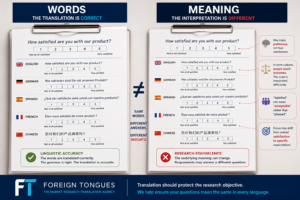
Why linguistic accuracy alone is not enough in international market research
There is a comforting assumption in multilingual research:
If the translation is accurate, the research will be accurate too.
Unfortunately, it is not quite that simple.
A translation can be linguistically excellent and still fail to reproduce what the original researcher intended.
That distinction matters.
Imagine a global consumer study being prepared in English and translated into ten markets.
The translated questionnaires are grammatically correct. The terminology has been checked. The spelling is perfect. Nothing has been mistranslated.
The project launches.
And yet, the responses from two or three markets look unexpectedly different.
The immediate temptation is to examine the data.
Perhaps consumer behaviour really is different.
Perhaps the market is an outlier.
Perhaps the sample has produced an unusual result.
But there is another question worth asking:
Did respondents actually understand the question in the same way?
Correct words. Different meaning.
Language does not operate in isolation.
A phrase that feels natural and straightforward in English may carry a different implication when expressed in another language.
A rating scale may be interpreted differently.
A concept such as “value”, “convenience”, “premium”, “trust” or “satisfaction” can have subtly different cultural associations.
And sometimes the English source itself leaves room for interpretation.
A professional translator may therefore raise a question that has nothing to do with grammar:
“What does the researcher actually want the respondent to understand here?”
That question can be extremely valuable.
Because once the questionnaire reaches programming and fieldwork, resolving that ambiguity becomes considerably more difficult.
This is why we encourage early involvement.
At Foreign Tongues, we believe translation should not be treated simply as the final step between questionnaire completion and fieldwork.
The earlier a translation partner understands the research objectives, the better positioned they are to identify potential linguistic or cultural issues.
That does not mean rewriting the researcher’s questionnaire.
It means giving the research team an opportunity to consider whether the intended meaning will survive the journey into another language.
Sometimes the answer is an unequivocal yes.
Sometimes a translator asks for clarification.
Occasionally, a small change to the source wording makes the question considerably more robust across markets.
That conversation is not an inconvenience.
It is part of quality control.
The hidden cost of “perfect” translation
The danger is that a linguistically perfect translation can give everyone a false sense of security.
The questionnaire looks finished.
The translations have been delivered.
The boxes have been ticked.
But if respondents in different markets are answering subtly different interpretations of the same question, the resulting data may not be genuinely comparable.
No amount of sophisticated analysis can completely eliminate that problem afterwards.
It is far better to identify it before fieldwork.
Translation should protect the research objective.
That is the distinction we believe matters at Foreign Tongues.
Our role is not simply to find the equivalent words.
It is to help preserve the intended meaning of the research as it moves between languages and cultures.
For a single-language study, that distinction may be largely invisible.
For a twelve-market study, it can become critical.
So the next time someone says:
“The translations are all correct.”
it may be worth asking one more question:
“Excellent. But are they all asking the same question?”
That is where good international research translation begins.
Thinking about your next multi-market study?
Talk to Foreign Tongues before the questionnaire reaches the final production stage. An early conversation can identify issues before they become problems in programming or fieldwork.
Foreign Tongues — The Market Research Translation Agency
